

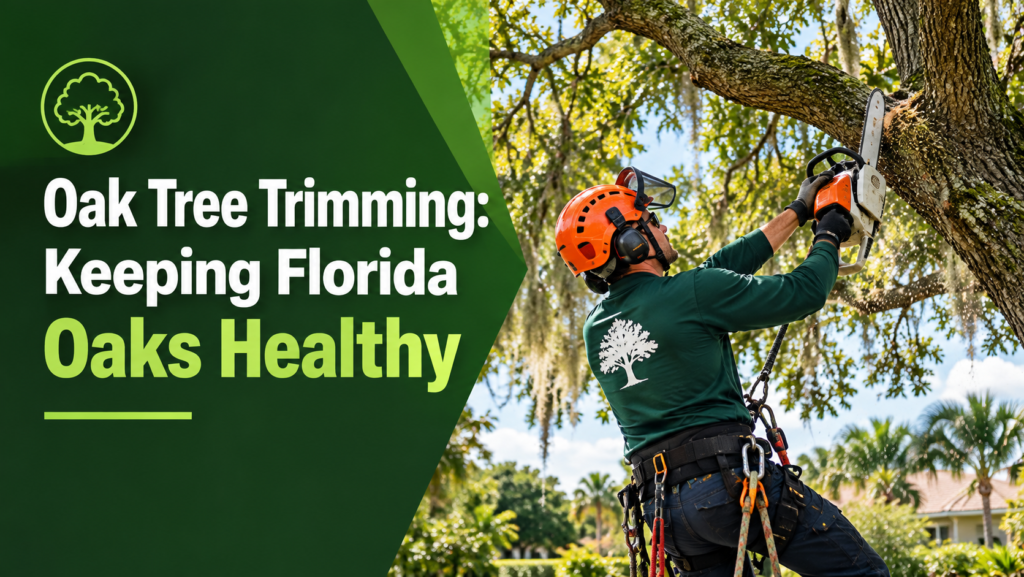
Florida is home to many beautiful oak trees that provide shade, wildlife habitat, and lasting value to residential and commercial landscapes. From majestic live oaks to laurel, water, and red oaks, these trees can become large and impressive features of a property. However, their size and spreading branches also mean that proper maintenance is important.
Regular pruning can help Florida oaks develop stronger branch structures, maintain appropriate clearance, and reduce problems caused by dead, damaged, or poorly positioned branches. UF/IFAS notes that proper pruning is particularly important for developing strong structure in live oaks, especially because weak branch attachments can become more problematic as trees mature.
Why Oak Tree Trimming Matters
Oak trees can live for decades or even centuries when they receive appropriate care. Because they grow large, structural problems that are ignored when a tree is young can become much harder and more expensive to correct later.
Proper oak tree trimming improves structure safety and long-term tree health. Strategic oak tree trimming can remove dead or damaged branches, address competing leaders, and encourage stronger branch attachments. UF/IFAS recommends developing a strong central leader and removing branches with narrow attachment angles because these branches are more likely to split as the tree ages.
Pruning can also help provide clearance around homes, driveways, sidewalks, fences, and other structures. A well-maintained canopy can make the landscape easier to manage while preserving the natural appearance that makes mature Florida oaks so attractive.
Common Reasons to Trim Florida Oaks
Removing Dead and Damaged Branches
Dead branches can become brittle and eventually fall. Damaged limbs can also create openings where decay or other problems may develop. Removing compromised branches helps reduce potential hazards while allowing the tree to focus resources on healthy growth.
After severe weather, homeowners should inspect trees for broken, hanging, or split limbs. UF/IFAS recommends removing broken or twisted branches while minimizing unnecessary removal of healthy wood.
Improving Tree Structure
Structural pruning is especially valuable when an oak is young. Multiple trunks, competing leaders, and branches with weak attachment angles can create structural concerns as the tree becomes larger.
For live oaks, UF/IFAS recommends eliminating multiple trunks and narrow-angled branches to encourage stronger development. Regular structural pruning early in the tree’s life can be more efficient than attempting to correct major defects after the tree has matured.
Maintaining Clearance
Branches sometimes grow toward roofs, driveways, walkways, utility areas, or other structures. Carefully selected pruning can provide necessary clearance without unnecessarily changing the tree’s natural shape.
The goal should not be to remove as many branches as possible. Instead, each cut should have a clear purpose that supports the tree and the surrounding property.
When Should Florida Oaks Be Trimmed?
Timing depends on the oak species, the tree’s condition, and the reason for pruning. A professional should evaluate the specific tree before deciding on a pruning schedule.
UF/IFAS resources emphasize that pruning should be planned around the tree’s structure, health, and intended objective rather than treated as simple canopy removal.
Young oaks may need more frequent structural attention as they develop. For example, UF/IFAS recommends regular pruning during the early years of live oak development to establish strong structure.
For mature trees, routine inspections can help identify branches that should be addressed before they become significant problems.
Proper Techniques for Trimming Oaks
Make Appropriate Pruning Cuts
Pruning cuts should be made carefully. UF/IFAS recommends making cuts just outside the branch collar when removing live branches. This approach helps minimize the amount of tissue affected by the cut and supports the tree’s natural response.
Large branches may require specialized techniques and equipment. Cutting them incorrectly can damage the trunk or create unnecessarily large wounds.
Avoid Excessive Pruning
More trimming does not necessarily mean a healthier tree. Removing too much living canopy at once can place unnecessary stress on an oak.
UF/IFAS explains that pruning dose should be considered carefully, with the ANSI A300 pruning standard recommending less than 25% of foliage or buds removed during a typical pruning treatment.
A professional tree care provider can determine how much should be removed based on the tree’s age, condition, species, and structural needs.
Preserve the Natural Shape
Healthy oak trees have naturally broad and distinctive canopies. Excessive topping or indiscriminate cutting can damage the tree’s appearance and structure.
Professional pruning focuses on selective cuts rather than removing large portions of the canopy simply to make the tree smaller.
Preparing Florida Oaks for Severe Weather
Florida’s storms can place substantial stress on mature trees. Strong structural development and appropriate pruning can help reduce certain risks associated with weak branches and poor architecture.
UF/IFAS research and guidance identify structural pruning as an important part of managing tree failure risk. Properly planned pruning can also provide clearance and help address defective branches before they become larger concerns.
However, pruning cannot guarantee that an oak will remain standing during a hurricane or severe storm. Trees should be inspected regularly, particularly when they are located close to homes, vehicles, walkways, or other valuable property.
Why Professional Oak Trimming Is Important
Large Florida oaks can be difficult and dangerous to prune without the appropriate training, equipment, and experience. Climbing a mature tree or cutting large limbs from the ground can expose homeowners to serious injury and can also result in accidental property damage.
A professional can evaluate the tree’s structure, identify hazardous branches, select appropriate pruning cuts, and determine whether additional tree care is necessary.
Professionals can also recognize species-specific concerns. Florida contains numerous oak species, and their growth habits and structural characteristics can vary. UF/IFAS identifies several Florida oaks, including live oak, southern red oak, laurel oak, and other species with different characteristics and maintenance considerations.
FAQs About Oak Tree Trimming
How often should an oak tree be trimmed?
There is no single schedule for every oak. Young trees may require more frequent structural pruning, while mature trees can often be inspected periodically and trimmed when specific needs arise.
Can I trim a large oak myself?
Small pruning jobs may be manageable for homeowners with the right knowledge and tools. However, large branches, tall trees, branches near structures, and trees with significant defects should be handled by trained professionals.
Does pruning help an oak withstand storms?
Proper structural pruning can help address weak branches and improve tree architecture. UF/IFAS research indicates that appropriate pruning methods can reduce certain risks associated with storm damage.
Should I remove branches with narrow angles?
Narrow branch attachments can be structurally weaker and may be more likely to split as the tree grows. Addressing these issues early can help develop a stronger tree structure.
Should pruning cuts be painted?
UF/IFAS advises that pruning paint, tar, and similar wound dressings are generally unnecessary and can interfere with the tree’s natural healing response.
Conclusion
Healthy Florida oaks can provide shade, beauty, wildlife value, and character for many years. Regular inspections and carefully planned pruning can help maintain strong structure while removing dead, damaged, or problematic branches.
Oak tree trimming should focus on the tree’s long-term health rather than simply making the canopy smaller. By using proper pruning techniques, avoiding excessive removal, and addressing structural problems early, property owners can help their oaks remain strong and attractive. When dealing with mature or difficult-to-access trees, professional tree care can provide the expertise and equipment needed to complete the work safely.