

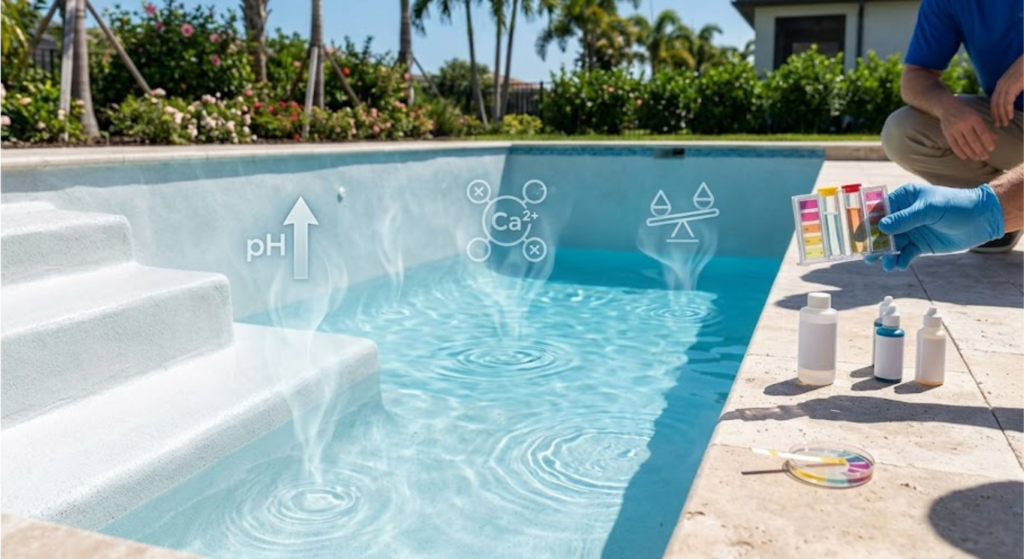
When Austin homeowners decide to renovate their swimming pools, the focus is almost always on aesthetics. You look at swatches of brilliant blue quartz, smooth white finishes, and premium river pebbles to find the perfect visual match for your backyard oasis. While choosing a beautiful finish is unquestionably exciting, seasoned pool professionals know that the interior surface of your pool plays a far more functional role than simply looking good.
The physical shell of your pool is in a constant, microscopic dialogue with the water it holds. Proper Pool Plastering Austin isn’t just cosmetic , it affects pH balance and water clarity. Clear Solutions applies coatings that maintain healthy conditions. If your pool’s chemistry is constantly swinging out of control, consuming massive amounts of acid or chlorine, an aging or improperly applied plaster shell is often the hidden culprit.
Here is an in-depth look at exactly how pool plastering impacts your water chemistry, and why investing in premium materials and expert application is the absolute foundation of a healthy, low-maintenance swimming pool.
1. The Curing Phase and the “Plaster Dust” Phenomenon
The most dramatic interaction between plaster and water occurs immediately after a new finish is applied. Traditional pool plaster is a carefully engineered masonry mixture of Portland cement, marble dust or aggregate, and water. Once the pool is filled, this cementitious surface does not simply dry; it undergoes an underwater chemical curing process that lasts for roughly 28 days.
During this critical start-up window, the new plaster leaches highly alkaline compounds—primarily calcium hydroxide—directly into the pool water.
- Spiking pH and Alkalinity: Because calcium hydroxide has an extremely high pH, your pool water’s overall pH and Total Alkalinity will rise rapidly.
- The Plaster Dust Effect: As these alkaline compounds react with the dissolved carbon dioxide in the water, they create calcium carbonate, which manifests as a fine, white cloudiness known as “plaster dust.” Managing this phase requires aggressive, daily chemical balancing. Professional pool plasterers work closely with technicians to perform specialized start-up procedures (such as an acid start-up or traditional bicarb start-up) to safely neutralize this alkalinity without damaging the fresh, curing surface.
2. Calcium Hardness and the “Hungry Water” Balance
Water is a universal solvent; it naturally seeks a perfectly balanced state of mineral saturation, measured by the Langelier Saturation Index (LSI). The relationship between your pool water and your plaster shell revolves entirely around calcium hardness.
If your water chemistry is out of balance, the water will actively use your pool’s plaster to correct itself.
| Water Balance State | Chemical Interaction with Plaster | Long-Term Surface Damage |
|---|---|---|
| Aggressive / Under-Saturated (Low pH, Low Calcium) | The water becomes “hungry” and actively dissolves calcium out of the masonry plaster shell to satisfy its mineral demand. | Results in severe surface etching, turning smooth plaster rough, highly porous, and structurally weak. |
| Scale-Forming / Over-Saturated (High pH, High Calcium) | The water cannot hold its dissolved minerals in suspension, forcing calcium carbonate to precipitate out of the water. | Results in scaling, leaving sharp, unsightly grey or white mineral deposits crusted over the plaster and waterline tile. |
Export to Sheets
3. Surface Porosity and Chlorine Demand
As a pool’s plaster ages, or if it is compromised by years of aggressive, acidic water chemistry, the microscopic surface becomes pitted and highly porous. This structural degradation has a severe, direct impact on your sanitizer efficiency.
- Harboring Micro-Contaminants: Microscopic pits and rough patches act as perfect, sheltered breeding grounds for persistent organic contaminants, particularly yellow and black algae. Once algae roots deep into porous plaster, standard brushing cannot remove it.
- Skyrocketing Chemical Costs: Because organic matter is constantly blooming inside these microscopic crevices, your free chlorine is forced to work overtime. Homeowners with aging plaster often notice their pools consuming double or triple the amount of liquid chlorine or tablets just to maintain basic, safe sanitization levels. Resurfacing the pool restores a tight, non-porous barrier, instantly stabilizing your sanitizer demand and keeping the water crystal clear.
4. Advanced Coatings for Ultimate Chemical Stability
To combat the chemical volatility of standard plaster, modern aquatic engineering has developed highly advanced, chemically resistant interior coatings. When you partner with elite specialists like Clear Solutions, you gain access to premium aggregate finishes designed to make water maintenance significantly easier.
The Aggregate Advantage: Upgrading from standard plaster to premium quartz aggregate or exposed pebble finishes introduces incredibly hard, non-reactive minerals into the matrix. Quartz and river pebbles are naturally impervious to chemical fluctuations. Because fewer cementitious binders are directly exposed to the water, these finishes leach far less alkaline material during start-up, resist acidic etching beautifully, and maintain a perfectly stable pH environment for decades.
5. Protecting Your Investment Through Professional Application
The ultimate success of your pool’s water chemistry begins the moment the plastering crew arrives on site. Applying pool plaster is a highly specialized trade that requires absolute environmental control, particularly in the blazing heat of Austin, Texas.
If plaster is mixed with improper water ratios, overworked by trowels, or allowed to dry too quickly in the sun before the pool is filled, the structural integrity of the finish is compromised from day one. Poor application leads to surface crazing, hydration check cracking, and spot etching, all of which create permanent chemical balancing nightmares. Trusting a proven, highly rated local contractor guarantees that your surface is mixed to exact architectural specifications and applied with masterful technique, securing a completely uniform, chemically stable shell.
Conclusion
Your pool’s water chemistry and its physical plaster shell are fundamentally linked. A pristine, expertly applied finish does much more than elevate the visual luxury of your Austin backyard; it actively stabilizes your daily pH levels, protects against structural mineral degradation, and dramatically lowers your ongoing chemical maintenance costs. When your pool surface begins to fail, don’t just treat the chemical symptoms. Invest in a lasting cure by partnering with Clear Solutions to apply advanced, durable plaster coatings that ensure your pool remains safe, beautiful, and perfectly balanced for years to come.
Frequently Asked Questions (FAQ)
Q: How soon can I swim in my pool after it has been newly plastered?
A: While the pool will technically be filled with water within 24 to 48 hours of application, you should generally avoid swimming for the first 7 to 10 days. During this initial window, the water chemistry is highly volatile, containing elevated levels of acid or unneutralized plaster dust, and the delicate curing surface can be easily stained or damaged by heavy foot traffic.
Q: Why does my pool water continuously require muriatic acid?
A: If your pool finish is relatively new, standard plaster naturally releases alkaline compounds that drive up your pH, requiring regular doses of muriatic acid to neutralize the water. If your pool is older, frequent pH spikes can be caused by highly aerated water features (like bubblers or cascading spas) pushing carbon dioxide out of the water, or from using highly alkaline liquid chlorine.
Q: Does installing a saltwater system damage pool plaster?
A: Saltwater itself does not directly damage high-quality pool plaster. However, saltwater chlorine generators naturally produce sodium hydroxide as a byproduct, which steadily raises the water’s pH. If a pool owner fails to monitor and lower this pH with acid regularly, the resulting scale-forming environment can deposit sharp calcium crusts across the plaster surface.