

Average Asphalt Cost per Square Foot
There is no single price that applies to every asphalt project. The answer to how much does asphalt cost depends heavily on what type of paving work is required.
A basic asphalt installation may cost around $3 to $7 per square foot, while more involved residential replacement projects can cost considerably more after demolition, excavation, base preparation, and disposal are included. Commercial parking lot projects may have lower per-square-foot costs because larger areas allow fixed mobilization and equipment expenses to be spread across more square footage.
Typical 2026 ranges can include:
- Asphalt overlays: approximately $3 to $7 per square foot
- New commercial parking lots: approximately $3 to $8 per square foot
- Residential full replacement: approximately $5 to $10 or more per square foot
- Heavy-duty commercial or industrial paving: approximately $4 to $8 or more per square foot
- Smaller or unusually complex projects: potentially $10 to $15 or more per square foot
These numbers are general estimates rather than guaranteed quotes. Local conditions can cause actual pricing to fall outside these ranges.
What Determines Asphalt Pricing?
When homeowners or business owners ask, how much does asphalt cost, they often focus only on the asphalt material itself. The material is important, but it is only one component of the total project.
**Material and labor drive overall pricing. ** Other expenses can include excavation, grading, aggregate base installation, demolition, hauling, drainage improvements, equipment, and site accessibility.
Here are some of the biggest factors that affect your final price.
Project Size
Project size has a major influence on the cost per square foot. Larger paving projects often have a lower unit price because contractors can distribute equipment transportation, crew mobilization, and setup costs across a larger area.
For example, paving a large commercial parking lot may have a lower per-square-foot rate than paving a small residential driveway. This does not necessarily mean that the contractor is charging more for residential work. Small projects simply have fewer square feet over which fixed costs can be distributed.
Small driveways can therefore have a higher cost per square foot even when the total project price is much lower.
Asphalt Thickness
The thickness of the asphalt layer is another important factor. A surface designed for occasional passenger vehicles does not necessarily require the same pavement structure as a parking lot used by delivery trucks.
Residential driveways commonly use a thinner asphalt section than commercial areas that experience heavier traffic. Some 2026 pricing guides place residential driveway installations around two to three inches of asphalt, while commercial applications may require three to four inches or more depending on traffic and engineering requirements.
More asphalt means more material, more hauling, and potentially additional installation time.
When comparing estimates, always ask contractors to specify the proposed asphalt thickness. A quote with a lower price may simply be offering a thinner pavement section.
Base Preparation
A strong base is essential for long-lasting asphalt. If the soil beneath the pavement is unstable, poorly compacted, or unable to drain properly, installing new asphalt over it may only provide a temporary solution.
Preparation can include excavation, grading, soil correction, installation of aggregate, and compaction. Published cost guides commonly estimate excavation and grading at roughly $1 to $3 per square foot in some markets, while gravel base installation can add additional costs.
Although base preparation increases the upfront investment, it can help reduce premature cracking, sinking, rutting, and other pavement failures.
Removal of Existing Pavement
If an old asphalt driveway or parking lot needs to be removed, demolition and disposal can add significantly to the project.
Contractors may need to break up or mill the existing asphalt, load it into trucks, transport it, and pay disposal or recycling charges. Some projects also require excavation beneath the old pavement because the underlying base has deteriorated.
For this reason, the answer to how much does asphalt cost can be very different for a brand-new installation compared with a complete tear-out and replacement.
Asphalt Overlay vs. Full Replacement
An asphalt overlay can be a more affordable option when the existing pavement is structurally sound.
During an overlay project, contractors generally prepare the existing surface and place a new asphalt layer over it. Some projects may involve milling the old surface before applying the new material.
An overlay is not appropriate for every pavement. Severe alligator cracking, major settlement, drainage problems, or structural base failure may require full removal and reconstruction instead. A 2026 pricing guide places mill-and-overlay work in a broad range of roughly $2.80 to $4.80 per square foot depending on region and specifications.
A professional assessment can help determine which approach makes sense.
Labor and Equipment Costs
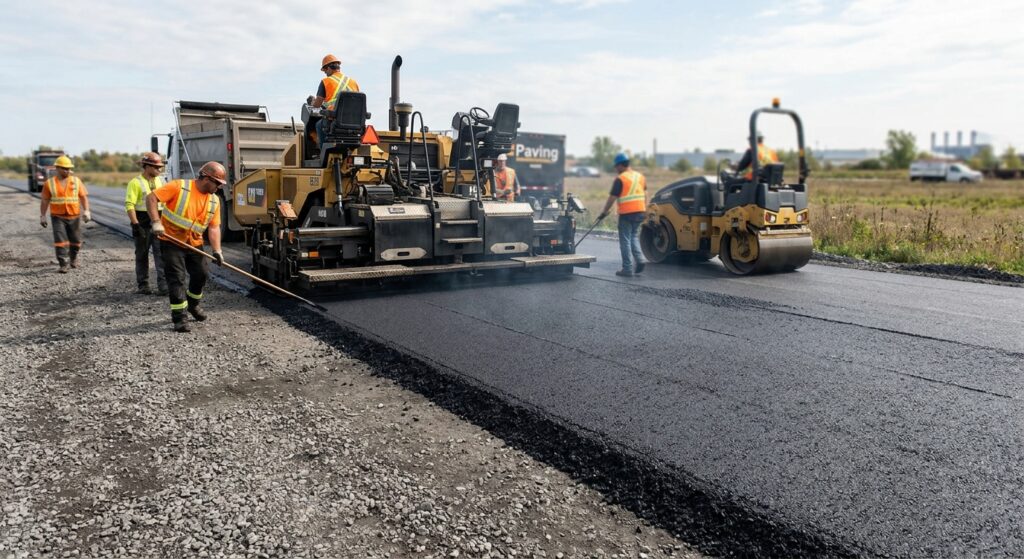
Paving requires specialized equipment and experienced workers. A typical project may involve asphalt pavers, rollers, trucks, skid steers, milling machines, and other equipment.
Labor costs depend on the size and complexity of the job, local wages, project schedule, and equipment requirements. A straightforward open site may be significantly easier to pave than a property with tight access, steep grades, landscaping obstacles, or restricted working hours.
Equipment mobilization can also influence small-project pricing because contractors still have transportation and setup expenses regardless of the size of the job.
Drainage and Grading
Water is one of the biggest threats to pavement. If water collects beneath or on top of asphalt, it can contribute to cracking, potholes, erosion, and structural deterioration.
A paving contractor may recommend grading improvements, drainage channels, catch basins, culverts, or other solutions before paving. These additions can increase the initial cost but may protect the pavement from water-related damage.
When asking how much does asphalt cost, make sure your estimate accounts for drainage work if your property has standing water or poor runoff.
Location Can Affect Asphalt Prices
Asphalt costs vary between regions because material, fuel, labor, transportation, and seasonal conditions differ.
For example, current Canadian pricing guides commonly place residential asphalt driveway costs around $3 to $10 per square foot, while individual markets can vary substantially.
In areas with severe winter weather, contractors may also need to account for freeze-thaw conditions, drainage, frost considerations, and seasonal scheduling.
If your property is in Southwest Florida, for example, you may want to consult a local naples paving company that understands regional soil, drainage, weather, and traffic conditions. A local contractor can provide a more useful estimate than a national average.
Example Asphalt Cost Calculation
Suppose you have a 1,000-square-foot area and receive an installed estimate of $5 per square foot.
The basic calculation would be:
1,000 square feet × $5 = $5,000
If another contractor quotes $7 per square foot, the comparable project would be:
1,000 square feet × $7 = $7,000
The difference is $2,000, but the lower quote is not automatically the better deal.
The $5 quote might exclude demolition, drainage, base preparation, or adequate asphalt thickness. The $7 quote might include those services.
This is why understanding how much does asphalt cost requires looking beyond the headline price.
How to Get an Accurate Asphalt Estimate
The best way to determine your actual paving budget is to request detailed estimates from qualified local contractors.
Before accepting a quote, ask:
- How many square feet will be paved?
- What asphalt thickness is being proposed?
- How much aggregate base will be installed?
- Is old pavement removal included?
- Is excavation included?
- Is grading included?
- Are drainage improvements necessary?
- Are hauling and disposal fees included?
- Are permits included if required?
- What maintenance is recommended after installation?
- What warranty does the contractor provide?
Comparing estimates on an identical scope of work makes it much easier to determine which proposal offers genuine value.
Choosing a Paving Contractor
Price should not be the only factor when selecting a contractor. Experience, workmanship, communication, insurance, licensing where applicable, references, and the quality of the proposed pavement structure are all important.
If you are searching for a naples paving company, look for a contractor that is familiar with local site conditions and can explain why a particular pavement thickness and base structure is appropriate for your property.
A reputable contractor should be willing to explain the estimate instead of simply providing a single number.
Ways to Control Asphalt Costs
There are several practical ways to manage your paving budget.
First, address drainage problems before installing new asphalt. Second, maintain an existing pavement surface when an overlay or repair is structurally appropriate. Third, avoid choosing a contractor based solely on the lowest quote. Finally, compare several detailed estimates that specify the same materials, thickness, preparation, and scope.
Routine maintenance can also help extend pavement life. Sealcoating, crack sealing, drainage maintenance, and timely repairs may reduce the need for expensive reconstruction later.
Final Thoughts
So, how much does asphalt cost per square foot? In 2026, many asphalt paving projects fall somewhere between $3 and $15 per square foot, although the appropriate range depends on whether you need an overlay, new installation, driveway replacement, commercial parking lot, or more complex reconstruction.
The biggest factors include project size, asphalt thickness, base preparation, existing pavement removal, labor, equipment, drainage, accessibility, and local market conditions.
Rather than focusing only on the lowest price per square foot, compare the complete scope of work. A properly prepared pavement structure installed by an experienced contractor can provide better long-term value than a cheaper installation that cuts corners on materials or preparation.
When you understand what is included in an asphalt estimate, you can make a more informed decision and budget more confidently for your next paving project.
Frequently Asked Questions
How much does asphalt cost per square foot in 2026?
Many asphalt projects in 2026 fall within approximately $3 to $15 per square foot installed, depending on project type, location, preparation, thickness, and accessibility. Residential and commercial projects can have significantly different pricing.
Is asphalt cheaper than concrete?
Asphalt is often less expensive to install than concrete, although actual costs depend on the project, location, thickness, preparation, and material specifications. Asphalt can also be repaired and resurfaced relatively efficiently.
How much does an asphalt driveway cost?
Residential asphalt driveway costs vary widely. Current pricing guides commonly report approximately $3 to $10 per square foot in many Canadian markets, while U.S. estimates can vary depending on location and scope.
Does asphalt thickness affect the price?
Yes. A thicker pavement section requires more asphalt material and may require additional preparation. Commercial areas that receive heavier vehicle traffic generally need a stronger pavement structure than residential driveways.
Is an asphalt overlay cheaper than replacing the pavement?
Usually, yes. An overlay can reduce costs because the existing pavement may remain in place. However, the existing pavement must be structurally suitable. Significant base failure, severe cracking, or drainage problems may require full replacement.
Why do small asphalt projects cost more per square foot?
Small projects often have higher per-square-foot costs because fixed expenses such as equipment transportation, crew mobilization, and setup are spread over fewer square feet.
What should an asphalt quote include?
A detailed quote should identify the project area, asphalt thickness, base preparation, demolition, excavation, grading, drainage work, hauling, disposal, labor, equipment, and any applicable permits or finishing work.
How can I find a reliable paving contractor?
Look for an experienced local contractor with appropriate credentials, insurance, references, clear written estimates, and a willingness to explain the proposed pavement structure. If you are in the Naples area, comparing several local paving estimates can help you understand the market and identify differences in project scope.